Market Summary by AFORTI: high inflation, the situation of the Polish zloty and difficult times on the WSE
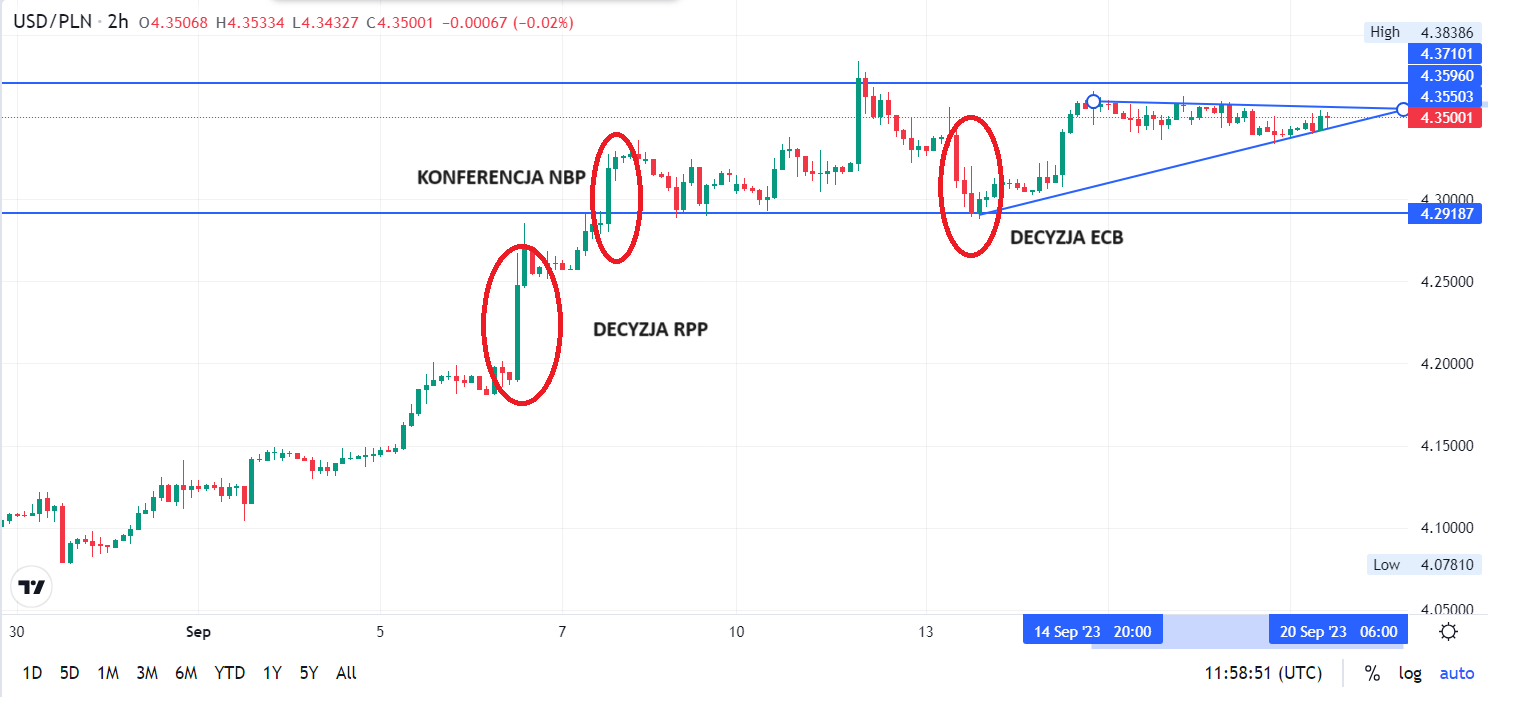
We have another week after the decision of the Monetary Policy Council, and the zloty still remains at weakened levels. After the market's violent reactions to the decision of the Monetary Policy Council and the conference of the President of the National Bank of Poland, there has been some calming down and waiting for what will happen in terms of local information, but also looking at the ECB and the FED. The increase in EUR/PLN rates to almost 4.7000 and USD/PLN to around 4.3650 certainly resulted in a change in previous forecasts. We have seen such a rapid weakening of the zloty in recent years only in two cases: the coronavirus pandemic and the start of the war in Ukraine. Shortly after this sudden move, we saw a total of 3 market interventions. One was verbal, and two were the presence of NBP on the market selling foreign currencies. It is estimated that this was an amount of approximately EUR 1 billion, which allowed to stop the uncontrolled weakening of the zloty to levels above 4.7000 and to further implement "stop-losses". It seems that the rapid flight of investors from the Polish debt securities market has ended, but optimism is still quite cautious and we are unlikely to observe an inflow of portfolio capital.
Data coming from the economy also showed that inflation is not willing to break the double-digit threshold downwards, and despite the "end of inflation" triumphantly announced at the NBP conference, it clearly did not follow his expectations - once again giving a reading of 10.1%. It should be recalled that such surprising movements in interest rates and the rapid weakening of the local currency affect the level of inflation.
However, here we come to another impact of the upcoming elections. Despite the increase in oil prices on world markets, the price in Poland is falling. Of course, Orlen's earlier increase in margins to levels that allowed the company (and the State Treasury) to realize gigantic profits. Now, even giving away part of the profits earned is beneficial to politicians who implement the election message about reducing fuel prices. However, it should be remembered that this is a very short-term measure and after the elections we may experience price shocks both in fuel and other products where the price of transport is important.
We would also like to remind you that we still have a zero VAT rate on food products. This period will also end soon - and for now, the reduced rate is valid until December 31, 2023. Restoring the previous rates means a release of approximately 1.8% to current inflation levels. Therefore, in our opinion, the optimism of the President of the NBP is very premature.
We remain in the shadow of the upcoming elections, we are dealing with polls that do not provide clear answers about the composition of the future Parliament or who will form the government. In the background, of course, we are also thinking about funds from the KPO, which, if released, could effectively change the exchange rate of the Polish currency - strengthening it in a short time, even to around 4.0000-4.1000. Please remember that we are talking about funds amounting to billions of EUR.
1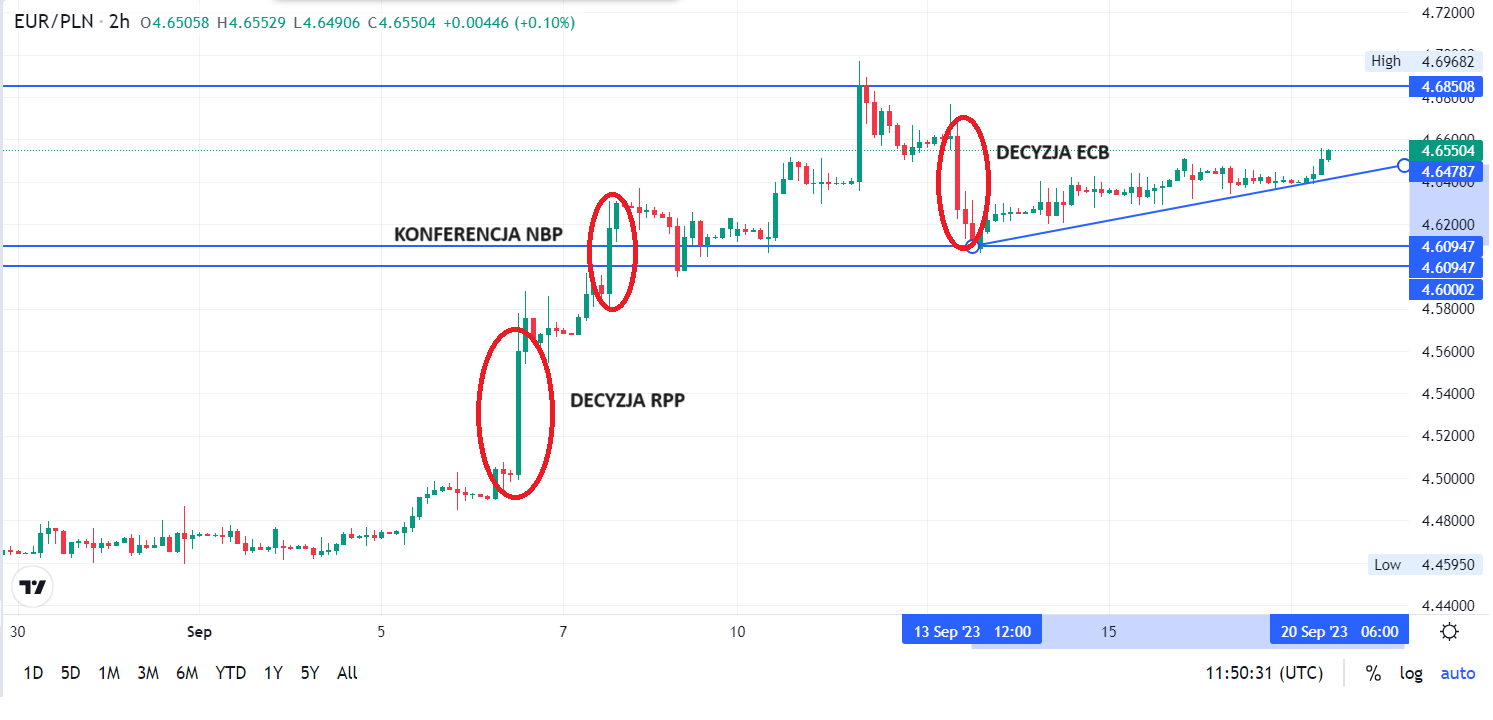
So how do we see the Polish currency in the coming days? Well, we do not expect it to strengthen, but rather to remain at levels above EUR/PLN 4.6350, with the possibility of weakening towards 4.6700. The US dollar stopped at the strong USD/PLN resistance of 4.3600, consolidating in a rather narrow corridor of 4.3400-4.3550. The FED meeting and the decision on interest rates will be clearly important here, but more on this later in the report. Although we can initially estimate that with unchanged rates, the currency is unlikely to make a sudden change, an upward change of 25bps may result in a sudden outflow towards investment in USD.
Looking at foreign markets - the ECB's decision to raise interest rates was the most emotional. Analysts' opinions were divided 60/40 - most of them predicted that the rates would remain unchanged. Our forecasts correctly estimated that an increase of 25 basis points would be realized. This change brought interest rates in the Eurozone to an all-time high. We are dealing with the last increase in this cycle - because further increases in rates could too much cool down the economies of EU countries, which are struggling with numerous economic problems.
Of course, we expect how the FED will react at the next meeting - but here we are betting that the expensive money policy will be maintained and there will be a favorable reaction of 25 basis points. This is not exactly a market consensus, but previous decisions and comments from the conference showed that the US wants to maintain its expensive money policy for the foreseeable future. On the one hand, there are already signals of slowing inflation, but on the other hand, some market indicator readings still seem to contradict this (PPI inflation, rising house prices and sharp increases in fuel prices).
Of course, the question arises as to how this will translate into the EUR/USD exchange rate and, indirectly, the Polish zloty. After the ECB's decision, there was a very strong move strengthening the common currency, which initially fell to around 1.0630 on the EUR/USD pair. The correction and return to the area of EUR/USD 1.0700 seem to confirm our assessment that with the movement of rates in USD, the demand for the American currency and the willingness to invest in dollars will increase. Therefore, such a move at tomorrow's meeting would mean the EUR/USD level closer to 1.0780-1.0800. No change in interest rates will probably result in a return to EUR/USD levels of 1.0660. Of course, it will be important for the markets to hear how Powell, the head of the Fed, justifies his decision. It will also be interesting to hear how he assesses the potential drop in interest rates in 2024 and whether he will continue to maintain that it will be 4 cuts of 25 basis points each. Decision tomorrow at 2:00 p.m., conference at 2:30 p.m.

Finally, very briefly about the situation on the Polish stock exchange. The stock exchange is clearly under pressure. The poor results of recent sessions are caused by reduced risk appetite and expectations of how the Fed's decision will affect global markets. Mainly banks and the energy sector declined on WIG20. The current level of WIG 20 has moved away from the strong resistance level of 2,000 and is now around 1,930. WIG behaves similarly, recording a level around 66,300, recording a drop of almost 3,000 points in 3 weeks. Will optimism return to the stock market? Probably yes, but investors should be expected to be very cautious before the elections.
Szymon Jańczak
Director of the Treasury Department
AFORTI Exchange SA