Market summary according to AFORTI: exposé of the new prime minister, budget act and interest rates unchanged
Looking at the last week, the main event was the swearing-in of the new government. As expected, Prime Minister Morawiecki's government did not obtain a parliamentary majority and the Sejm voted on a vote of confidence in Prime Minister Tusk's government, which obtained the appropriate number of votes to appoint a new cabinet, which was sworn in on December 13. The markets received this information positively, especially in the context of the announcement of the rapid release of KPO funds, the reduction of the fiscal deficit and the previously declared budget transfers, which are intended to ultimately increase consumption, without the previously assumed inflationary pressure. The information that was not included in Prime Minister Tusk's expose concerns primarily the issue of tax changes introduced as part of the "Polish Order" - specifically, the issue of health insurance contributions and their tax deduction. The second issue that appeared earlier as an election promise but was not mentioned - increasing the tax-free amount (PIT) to PLN 60,000. Both of these topics will probably be repeated in questions, but for now we should refrain from making specific calculations - until the 2024 budget is approved. It should be noted that the time left for the "October Fifteenth Coalition" to adopt the budget has been shortened by almost 2 months, which was consumed by political games. The issue of adopting the budget is important because failure to obtain consensus and adopt the financial act on time results in the dissolution of Parliament and the calling of early elections. The document must be signed by the President by the end of January 2024. Let us add that the budget bill cannot be vetoed by the president. The current government therefore has exactly 6 weeks to work on the bill, when the usual time is about 4 months. Certainly, the budget prepared by the previous government will be significantly revised, both in terms of the size of the deficit and the assumptions related to the financing of declarations made during the election campaign. Preliminary estimates indicate an additional amount that will increase the assumed budget by approximately PLN 40 billion. It should be mentioned that the initial budget proposal prepared by the previous government did not include the issue of extending zero VAT on food. In the last days of the previous government's term of office, this period was extended by regulation until the end of the first quarter of 2024, which will reduce budget revenues by approximately PLN 2.9 billion.
From the point of view of public finances, it is also worth noting that in the budget proposal, the previous government assumed a payment of PLN 6 billion from the National Bank of Poland - as a realized profit realized by our central bank. Meanwhile, it turns out that the NBP's loss for 2022 is PLN 17 billion, and 2023 is to end with a loss, initially estimated at PLN 20 billion.
We will probably obtain more information after the first meeting of the new government, which is scheduled for December 19, 2023. A working meeting was held the day before, but it was more focused on administrative issues.
Looking at other information coming from the Polish market, the Monetary Policy Council did not change the level of interest rates at its last meeting in December. The CPI consumer inflation readings certainly had an impact, which stopped at 6.6%. According to our previous analyses, this situation means that the declines have stopped and we may continue to see such levels for a longer time.
The core inflation value for November announced on Monday (CPI excluding food, fuel and energy) was 7.3%. This means another decline after the values of 8.4% in October and 8.4% in September. However, this should be looked at from the perspective of the NBP's inflation target, which assumes a value of 2.5% (+/- 1 percentage point). This is therefore three times the value assumed in the inflation target. Taking into account the previous very low interest rates, which were also outside the corridor of inflation assumptions, we are dealing with obvious problems for the NBP in meeting the assumptions set for the NBP.
As for the currency, we are dealing with a positive assessment related to the appointment of a new government. The market has already initially discounted the payment of advances in EUR, which, however, will not necessarily be fully converted. As a result, the Polish currency gained, briefly breaking the EUR/PLN level of 4.3000, and then corrected to the area of EUR/PLN 4.3200-4.3500. This ultimately met our expectations from November. The rebound in EUR/PLN is obviously related to increased purchases in the pre-Christmas period and the demand for foreign currency. As we can observe, exporters still expect that the zloty will lose, but in our opinion the level of 4.3500 is such a strong resistance that the zloty will return to the EUR/PLN corridor of 4.3100-4.3350 in the coming days. The exchange rate will, of course, be influenced by the closing of currency positions related to the end of the year and "Windows dressing" - i.e. obtaining the best balance sheet/income statement structure for company purposes.
EUR/PLN over the last 10 days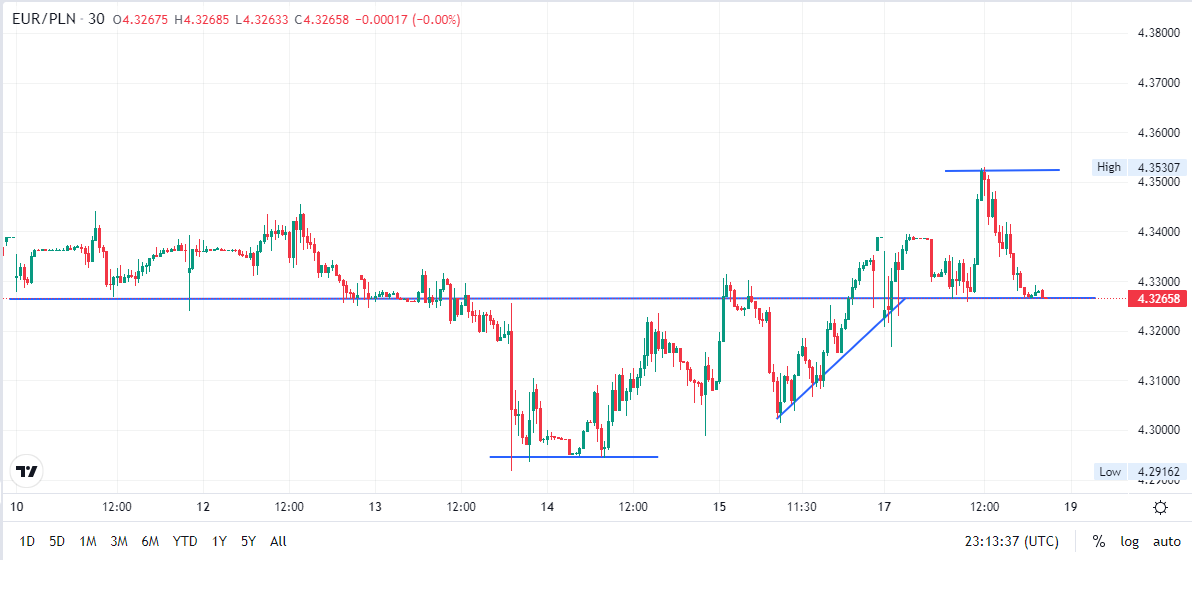
Looking at the American currency, the dollar, which initially remained above the psychological level of USD/PLN 4.0000, gained rapidly after the FED meeting to reach the level around USD/PLN 3.9200 at the end of the previous week. Such movements in the American currency were, of course, influenced by changes in EUR/USD, where the dollar broke through the resistance in the rather narrow EUR/USD corridor of 1.0780-1.0800 in order to quickly reach the strong resistance level of EUR/USD 1.1000.
What was important for these changes was the FED meeting, where interest rates, as expected, remained unchanged (5.25-5.50%). Jerome Powell, commenting on the decision in the context of falling inflation, announced that there is no further need to raise rates, and a cycle of reductions will begin in 2024. Investors started looking for good assets that would bring the expected rates of return. Therefore, stock markets, bonds and gold were gaining. The question remains what interest rate cuts we can count on. According to our previous assessments, 3 cuts of 25 basis points each are a scenario we can count on. We expect the first reduction in the second quarter, and the next two in the third quarter. Yields on 10-year US bonds have consistently fallen below 4%, which shows that the market assumes that the economy is gaining momentum and inflation will be kept in check.
USD/PLN over the last 7 days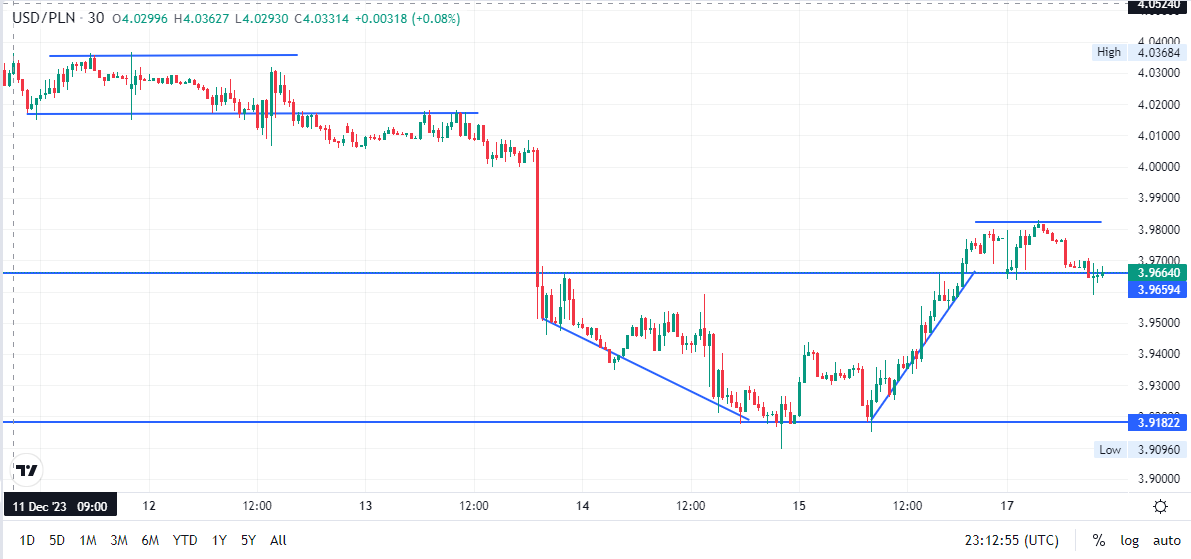
At the same time, changes in the rates of the main currency pair were influenced by more cautious statements by Christine Lagarde, the head of the European Central Bank. Suggestions to keep interest rates unchanged - at least until the end of the first quarter of 2024, meant that the EUR zone was still struggling with inflationary pressure and it would take longer than initially expected to loosen the interest rate policy. The ECB kept the main interest rate at 4.5%. In total, the decisions of the FED and ECB resulted in the strengthening of the EUR against the USD.
Last week, decisions were also made in the UK and Switzerland. Both central banks kept rates unchanged. In the UK, the main interest rate is currently 5.25%, and the statement after the meeting states that in the event of further inflationary pressure, the Bank of England will take decisive steps by raising interest rates to higher levels.
In turn, the Swiss kept rates at 1.75% due to surprisingly good information on the decline in inflation, which amounted to 1.4% vs. the expected 1.9-2.0%
EUR/USD over
the last 30 days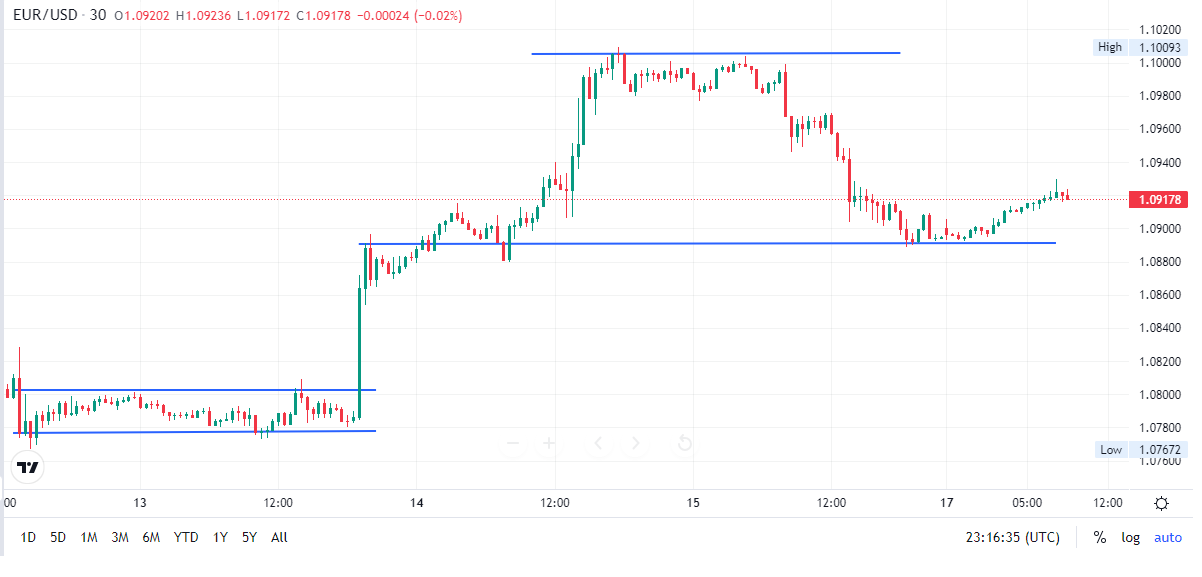
Looking at the raw material markets - especially BRENT crude oil - high price volatility is visible. Initial assumptions about reduced demand, supported by higher production, caused the oil to drop to levels around USD 72.20.
Information about increased demand from the Chinese market and decreasing stocks caused prices to return to around USD 80.00. At the same time, it should be assumed that OPEC countries will try to reduce production in order to maintain the assumed prices, which they estimate in the USD corridor of 80-84.00
BRENT crude oil
– last month USD/barrel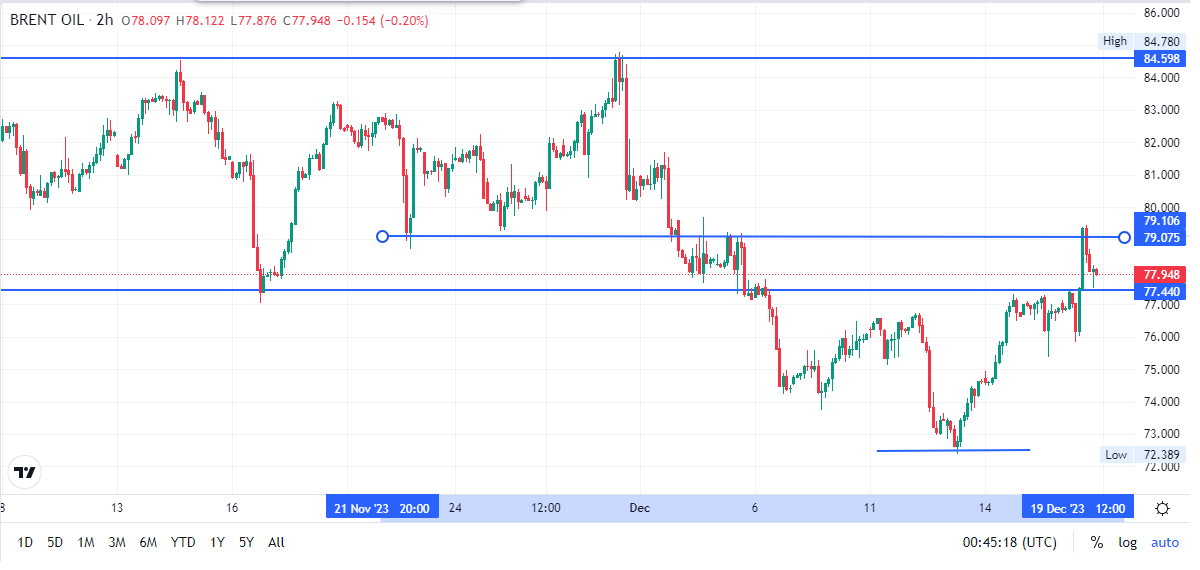
Gold - on the wave of words coming from the FED, is again among the attractive assets. This resulted in a break above the level of USD 2,000/ounce, reaching almost USD/PLN 2,090 in early December, correcting around USD 2,040.
Finally, a
short look at the stock markets. There is exceptional optimism on the Warsaw
Stock Exchange. Investors made record purchases, both directly and through
equity funds. On WIG20, the level of 2,300 above was maintained - at times
reaching almost 2,360 points.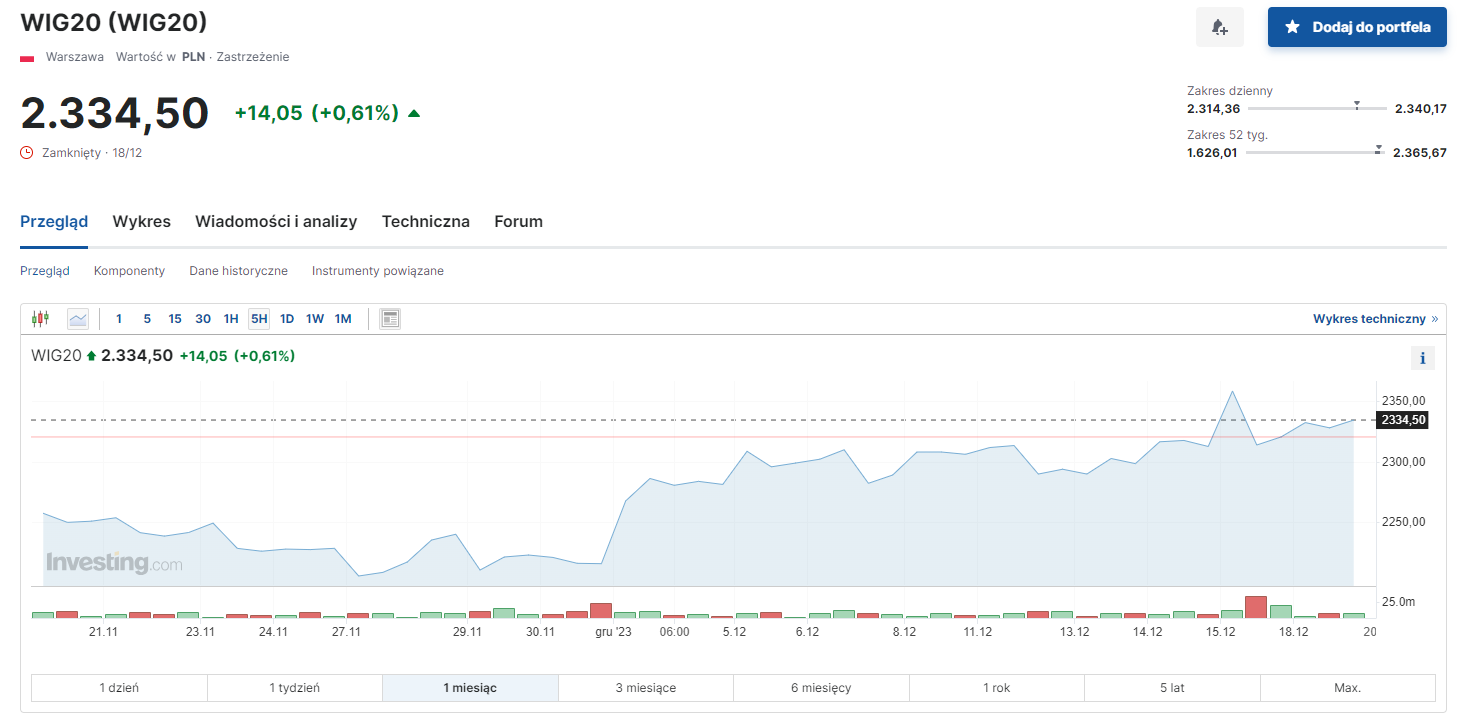
We saw record levels on WIG again - above 76,000, reaching almost 79,200. It seems that optimism is here to stay and many investors want to take advantage of the increases by joining the recent regular increases.
Szymon Jańczak
Director of the Treasury Department
Aforti Exchange S.A.