AFORTI Market Summary: where EUR/USD is heading, difficulties of the Polish economy and BRICS consolidation
The last week of the holidays starts quite calmly when it comes to currency markets. This may be partly due to the holiday in the City of London, but also Monday does not bring significant data.
The main focus, of course, is on the direction the EUR/USD rate will go, but the Chinese economy is looking at the further direction.
So let's look at the important market elements that will shape the coming days.
The already mentioned EUR/USD draws attention primarily to further movements in the interest rate markets. The dovish statements of Christiane Legarde, the head of the European Central Bank, show that some economists believe that the cycle of increases is over and believe that inflation in the euro zone has been brought under control. On the other hand, its opponents - such as the President of the Bundesbank - Joachim Nagel - believe that price stability has not been achieved and the valuation of short-term (2-year) bonds still shows inflationary pressure. Although positive PMI readings calmed down some investors in Europe, there is a growing expectation for data that are to be released this week from the EU and the US. Let us add that the data coming from the German economy are still far from optimistic, and inflation expectations are over 6%. Italy (below 6%) and France (slightly above 4%) are slightly better in this respect.
On the other hand, we will also observe data from the US, where the head of the Fed - Jerome Powell - talks about the continued high cost of maintaining the cost of financing the deficit and further increases in interest rates.
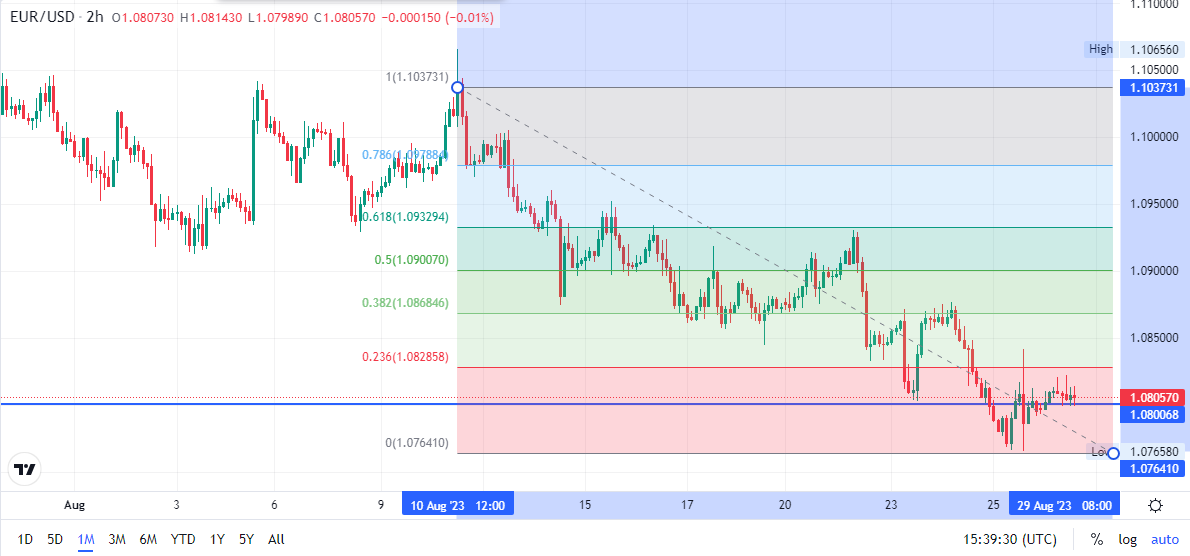
The market, awaiting the data, consolidated around the EUR/USD 1.0800 level – in clear anticipation of what data will surprise the market more. However, it does not seem to us that the further march to the south will be continued.
When analyzing the Polish market, the data coming from the Polish economy
are becoming less and less understandable and difficult to interpret. We have
intertwined data on GDP growth in the first quarter by 4%, then the second
quarter brings us data on a decrease in GDP by 3.7%. We can try to analyze this
information by looking at the data through the prism of seasonality - but even
the imposed filters - intended to show the true picture of periodic
fluctuations - do not fully manage to sort out these ambiguities.
So can we talk about clear conclusions and making a clear diagnosis of where we are now - in terms of the business cycle? Again, it's hard to come up with a clear and simple answer. Especially that we do not receive a clear message neither from the Central Statistical Office nor from the NBP, and the data and reactions to what is happening on the market are not fully rational.
Undoubtedly, the economy is unstable after the pandemic - and many of the earlier market reactions have ceased to be subject to known models and calculations that allowed for quite accurate analysis of trends and predicting the condition of the economy.
Different consumer behavior and previous low interest rates meant that we faced strong pro-inflation trends. The delays in the NBP's reaction to stopping the accelerating inflation imposed on this resulted in price increases and a strong base effect pushing prices to higher levels.
On the other hand, it was accompanied by strong wage pressure, and strong demographic changes - related mainly to the influx of refugees from Ukraine - meant that the Polish labor market was developing very dynamically. This situation somehow balanced out opposing changes/data, and the decrease in consumption - although it occurred, did not suppress demand and price increases in the expected way. The high exchange rates of foreign currencies against the zloty, which have been maintained for quite a long time, have also allowed exporters to take advantage of increased profitability.
So can we say that we are not threatened by recession or stagnation? One cannot forget about the outflow from the Polish labor market and the growing costs of servicing foreign debt. Economists also agree that there is no clear way of assessing the budgetary situation, as a large part of the expenditure has been taken outside the budget and is not subject to Parliament's scrutiny. In the light of this, the upcoming elections and further uncertainty as to the direction of obtaining funds from the KPO certainly do not calm the situation.
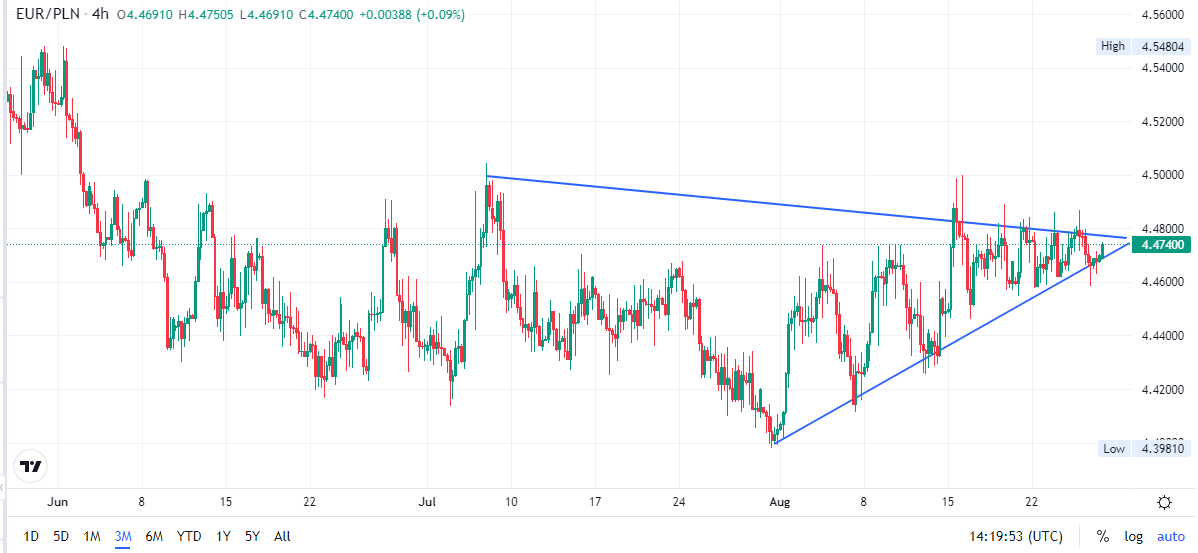
So what are the expectations for EUR/PLN? Certainly, a clear wedge has formed, which will probably also indicate the direction after the publication of data from the EU and the US. The stop and resistance at the level of EUR 4.4850 is an obvious waiting for the situation on the market.
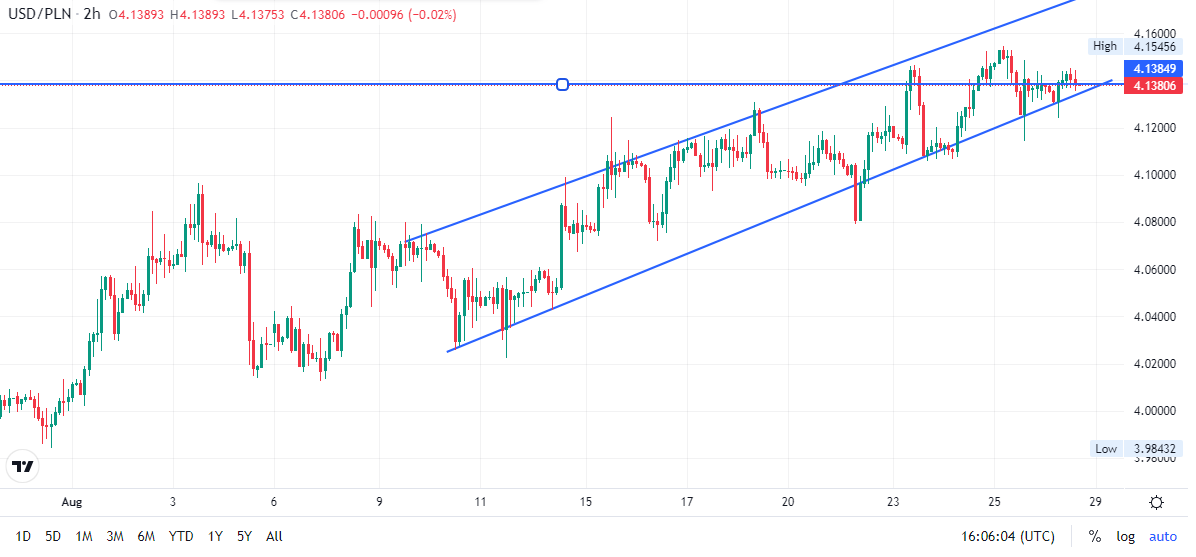
For USD/PLN following the EUR/USD rate, we see exactly the same level of anticipation. So - around USD/PLN 4.1380 became a place of waiting for data.
Finally, let's also look at other markets, where there are increasingly clear signals that China is getting closer to stagnation, and the strong locomotive that has been the Chinese economy so far is starting to get short of breath. Let's remember that the Chinese economy with its market capitalization (right after USD) has a strong influence on other markets and on its partners from the US and Europe.
Another interesting piece of information is the tightening of relations within the BRICS group (Brazil, Russia, India, China and South Africa) and expansion to new countries: Saudi Arabia, Argentina, Egypt, Ethiopia, Iran and the United Arab Emirates. These countries are currently talking about creating a strong group with a gold-backed currency and promoting a new system of international settlements. Certainly, such a group will be a serious player and jointly representing the interests of this group of countries will strongly influence the network economy.
Finally, very briefly about the situation on the Polish stock exchange. As we mentioned a week ago - the 2,000 level has put up strong resistance, and investors' return to the stock market after the holiday period may involve an attempt to attack the 2,200 level again. There was also some optimism on the WIG, but the level to be broken - 69,000 can wait a little longer for a strong signal.
Simon Janczak
Director of the Treasury Department
Aforti Exchange S.A